Will a 20-Yard Dumpster Fit in Your Driveway? Space and Clearance to Check
September 23, 2026
Short term and long term dumpster rentals split along one line: whether your debris shows up all at once or keeps trickling in. Get that right and the rest falls into place.
Short term rentals are built for projects with a hard stop. Think a single garage or basement cleanout, one room torn down to the studs, a move out, or an estate clearing. The debris comes fast and then it's done. Most short term drops sit for two to seven days, which is plenty when the work happens in one push. Spring cleanouts after the snow finally melts and fall yard purges before the first hard freeze fit this pattern almost every time.
Long term rentals earn their keep when the mess arrives in waves. A whole house remodel, a new addition, ongoing commercial turnover, or landscaping spread across a season all feed a bin in bursts with quiet stretches between. These rentals run weeks, sometimes a month or more. The bin becomes part of the job site, not a one time visit. Because the building season is short, a lot of long term containers go out in summer when crews are racing to finish exterior work before cold weather shuts it down.
Quick Answer: A 20-yard dumpster runs about 22 feet long and 7 to 8 feet wide, but the container's footprint is only part of the equation. The delivery truck needs roughly 60 feet of relatively straight, clear space to line up, lower the container, and pull away, plus about 20 feet of open space overhead while the hydraulic bed lifts and lowers. Add a few feet of width on each side for mirrors and steering room, and check the ground itself for cracks or soft spots that a loaded container could stress. Most standard driveways handle a 20-yard fine, but narrow entrances, low branches, and short driveways sometimes call for a smaller size or a different spot on the property.
You walk out to the driveway with a tape measure, trying to picture where a dumpster the size of a small moving truck is supposed to go. Maybe you're planning a full roof tear-off, a whole-house cleanout, or a renovation that's about to generate more debris than you want to think about. The dumpster itself sounds simple enough — drop it here, fill it up, someone hauls it away. Then you start looking at your driveway and wondering if 22 feet of steel is actually going to fit between your garage and the street.
It usually does. But "usually" isn't good enough when a truck is already on its way, so here's what actually determines whether a 20-yard container works on your property, and what to check before delivery day instead of finding out the hard way.
What a 20-Yard Dumpster Actually Takes Up
Start with the container itself, since that's the number most people fixate on and the easiest one to get wrong.
Length
A 20-yard roll-off typically measures around 22 feet from end to end, give or take a foot depending on the manufacturer. That's longer than most cars, close to the length of a full-size pickup with a trailer attached. If your driveway runs shorter than that, the dumpster may need to sit at an angle, hang slightly into the yard, or move to a different spot entirely.
Width
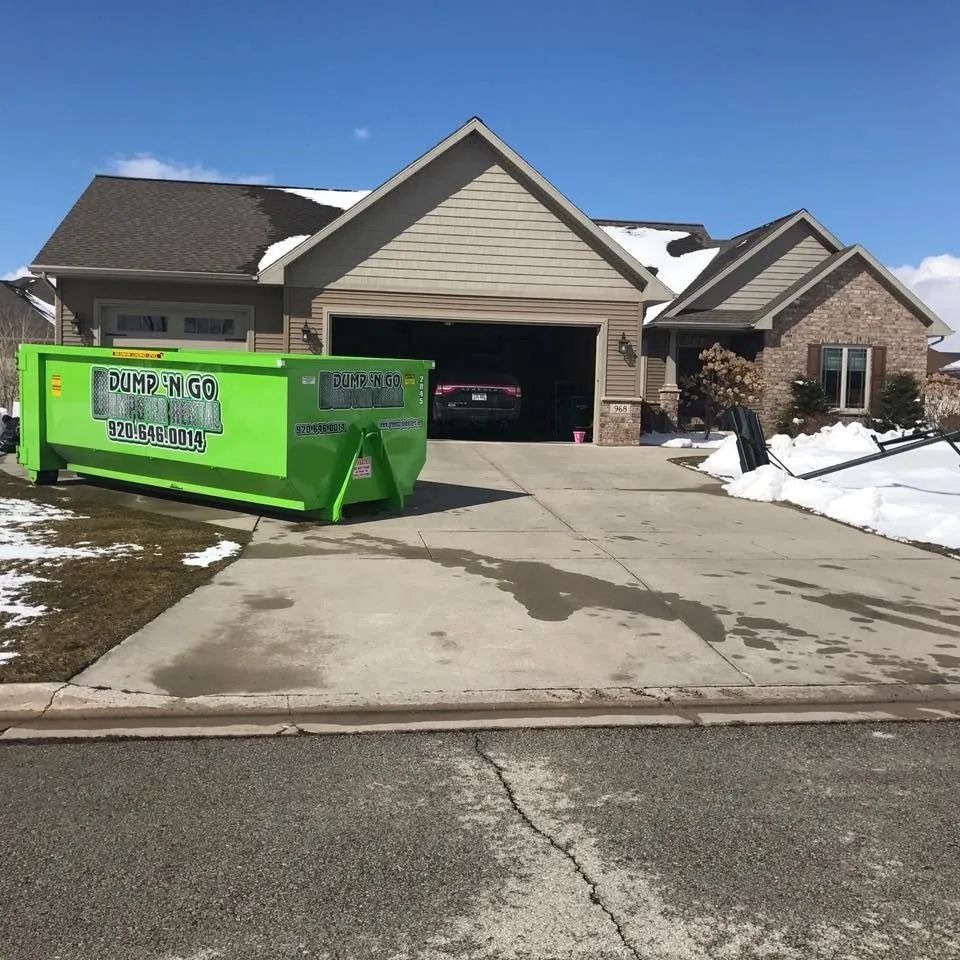
Most 20-yard containers sit around 7 to 8 feet wide, with walls standing roughly 4 to 5 feet tall — tall enough to hold a lot of debris, short enough that height rarely trips anyone up on the ground. On paper the width sounds narrow. In practice, a standard two-car driveway usually has room to spare, but a single-car driveway or an older, narrower drive common in parts of Green Bay's established neighborhoods can feel tight fast.
The real clearance concern isn't the container's own height. It's what happens above it once the truck starts working, which we'll get to in a minute.
None of these numbers mean much in isolation. What matters is how they interact with your specific driveway, your gate, your fence line, and the truck that has to get the container there in the first place.
Why the Truck Needs More Room Than the Dumpster Itself
Here's the part that catches people off guard: measuring the dumpster and measuring what you need aren't the same exercise.
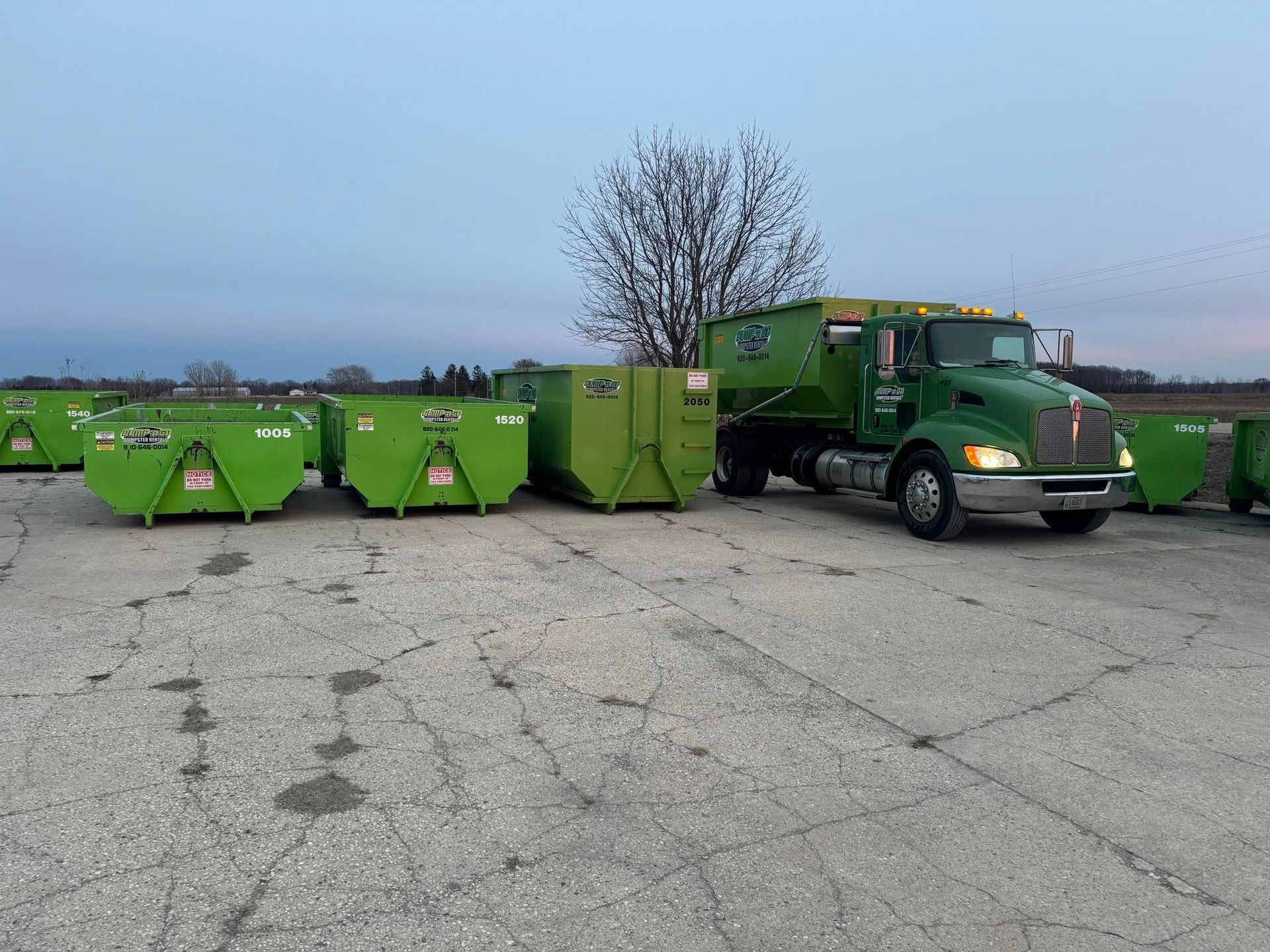
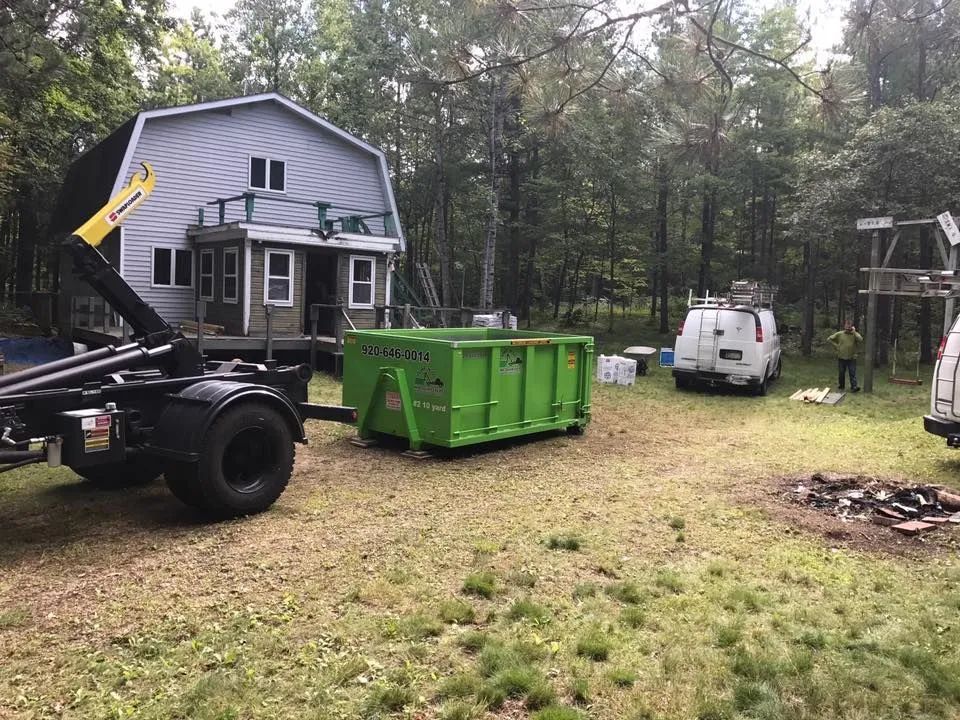
A roll-off truck doesn't just drop a container and drive off. It pulls onto the property, aligns itself with the exact spot you want the dumpster, raises its hydraulic bed, and slides the container backward until it settles into place. Picking it up later works the same way in reverse. That whole process needs a straight approach and enough length behind the placement spot for the truck itself, which is why most rental companies ask for somewhere around 60 feet of relatively clear, flat space from the street to the final resting point.
Sixty feet sounds like a lot until you realize it includes the street, the driveway apron, and the driveway itself — not just the container's footprint. A typical suburban lot in Ashwaubenon or Bellevue often has that much room without anyone measuring a thing. Shorter or curved driveways are where the math gets tighter, and that's exactly when a phone call before delivery day saves everyone a headache.
Width matters here too, and not just for the dumpster. The truck itself is close to 8 feet wide, and the driver needs a few extra feet on each side to steer without clipping a fence post, a mailbox, or your neighbor's parked car. A driveway that's exactly wide enough for the dumpster usually isn't wide enough for the truck that delivers it.
Checking the Path In, Not Just the Spot It Lands
Most homeowners measure the final parking spot and stop there. That's the wrong place to stop.
Gates And Gate Posts
If your driveway has a gate, measure the actual gap between the posts — not the driveway behind it. A truck that can't get through a 9-foot gate opening never reaches the wider space beyond it.
Fences, Walls, And Landscaping
Retaining walls, garden beds, and decorative fencing along the driveway edge shrink the usable width even when the pavement itself looks plenty wide. Walk the length of your driveway and note anywhere it narrows, even by a foot.
Parked Vehicles
A car parked at the curb or in the street across from your driveway can block the truck's approach angle entirely, even when your own driveway is completely clear. Plan to move vehicles well before the delivery window, not right as the truck pulls up.
Mailboxes And Utility Boxes
These sit right at the edge of most driveways and rarely get a second thought until a truck mirror is inches from clipping one.
TIP: Walk your driveway from the street to the planned dumpster spot the same way the truck will approach it — straight on, not from an angle. If you can picture a moving truck making that same path without a three-point turn, a roll-off truck can probably manage it too. If you can't, that's the sign to call your rental company before scheduling delivery, not after.
Look Up Before You Look Down
Ground-level obstacles get most of the attention, but overhead clearance causes just as many delivery problems, and it's the one homeowners forget to check.
The truck's hydraulic bed rises well above the cab as it lifts and lowers the container, and that motion needs open air above it — typically somewhere in the range of 20 feet or more of overhead clearance, depending on the specific truck. Low tree branches, power lines running from the street to the house, roof overhangs, carport roofs, and even hanging basketball hoops can all interfere with that motion.
A spot can look perfectly open at eye level and still be unsuitable once you account for what's directly above it. Mature trees along older streets in Allouez or De Pere often have branches that crept out over the driveway years ago without anyone noticing, right up until a delivery truck needs the space back.
Never trim branches near a power line yourself, and never attempt to move a utility line out of the way. If overhead clearance looks questionable, the better move is picking a different spot on the property or flagging the concern with your rental company ahead of time so they can plan around it.
What the Ground Underneath Is Actually Holding
A driveway that measures out fine on length, width, and height can still be a poor fit if the surface itself isn't up to the job.
Concrete And Asphalt Condition Matters
A loaded 20-yard dumpster carrying construction debris, shingles, or a mixed renovation load puts real weight on a small footprint. Existing cracks, soft or crumbling sections, and driveways already showing wear are more likely to stress further under that load, especially where the container's steel skids make contact. Asphalt adds its own wrinkle — it softens in summer heat and can be more vulnerable to indentation from a heavy container sitting in one spot for days, and around here that stretch of hot, humid weeks in July and August is exactly when driveways are at their softest.
Slope And Drainage Play A Role Too
A driveway with a noticeable pitch can make it harder to position a container level, and water pooling around a dumpster during a rainy stretch isn't doing your pavement any favors either.
WARNING:
Never assume a driveway can handle a loaded dumpster just because it looks solid. Hairline cracks, a section patched years ago, or a slab poured over unstable fill can give way under sustained weight even when the surface looks fine to the eye. If you have any doubt about your driveway's condition, mention it before delivery so the crew can plan the placement — or protective boards — accordingly.
Narrow, Short, or Sloped Driveways: What Your Options Look Like
Not every property has 60 feet of straight, flat driveway leading up to a wide-open spot next to the garage. Older homes in established parts of Green Bay, Howard, and Hobart often have narrower lots, shorter driveways, or a garage set at an angle that complicates a straight approach.
If your driveway comes up short on length or width, you generally have a few real options. Placing the container closer to the street shortens the truck's approach distance, even if it means carrying debris a little farther to load it. A smaller container — a 15-yard or even a 10-yard — has a shorter footprint and needs less approach room, which sometimes solves the whole problem without touching the driveway at all. And in some cases, a side yard or a section of a wider lot works better than the driveway ever would, provided the ground is stable and the path to reach it is clear.
Winter adds its own wrinkle here, too. Snowbanks pushed to the edges of a driveway after plowing can eat several feet of usable width without anyone realizing it until a truck shows up. If you're planning a rental during a Northeast Wisconsin winter, factor in where the snow gets piled and clear it back further than you think you need to.
Getting an Accurate Answer Before Delivery Day
None of this requires guesswork on your part. The most reliable approach is simple: measure your driveway's length and width, check the gate or entrance opening if you have one, look up for branches and wires, and take a hard look at the surface condition. Share those details, along with a photo or two if you have them, before your delivery is scheduled.
A driveway that seems questionable on paper often turns out fine once someone experienced looks at the actual layout — and a driveway that seems obviously fine sometimes has a narrow gate or a low branch nobody thought to mention. Either way, that conversation before the truck arrives beats troubleshooting in the driveway while the truck idles at the curb.
Frequently Asked Questions
Will a 20-yard dumpster fit on a normal residential driveway?
In most cases, yes. A standard two-car driveway usually has enough length and width for the container and delivery truck. Exceptions include older, narrower driveways, short driveways, or a gate or wall narrowing the path.
How much overhead clearance does a 20-yard dumpster actually need?
Plan on 20 feet of open space above the placement spot and the truck's approach. That room covers the hydraulic bed rising during delivery, not the container's height, which stays near 4 or 5 feet.
What if my driveway is narrower than a 20-yard container needs?
A smaller container, like a 15-yard or 10-yard, has a shorter length and fits where a 20-yard's footprint won't work. Placing it closer to the street, or using another flat area, solves a tight driveway.
Can a 20-yard dumpster go on the street instead of the driveway?
It's sometimes an option when a driveway can't fit the container, though placement depends on your property and street layout. If your driveway looks questionable, mention that upfront so a different spot gets planned early.
Does a curved or sloped driveway change whether a 20-yard dumpster fits?
It can. Trucks deliver roll-off containers along a straight approach, so a sharp curve or steep pitch may need a different placement spot even if the length measures fine. A slope also makes leveling harder.
How do I know if my driveway can handle the weight of a loaded 20-yard dumpster?
Look for existing cracks, soft spots, and patched areas, especially where the container's skids make contact. Hot summer stretches soften asphalt. If your driveway shows these signs, flag it before delivery so placement can adjust.
Getting the Fit Right Before Delivery Day
A 20-yard dumpster fitting your driveway comes down to more than one measurement. The truck's approach, the overhead room for the hydraulic bed, and the driveway surface itself all matter alongside the container's length and width. Most residential driveways handle a 20-yard container without complication, since the needed space usually already exists between the street and the garage. Properties that run into trouble almost always have one specific reason, whether that's a narrow gate, a low branch, or a surface already showing wear.
Dump 'N Go
has spent 10+ years serving driveways across Green Bay, WI and the surrounding Brown County area, and that stretch of experience shapes how confidently a fit gets confirmed. A tape measure, a quick look overhead, and an honest read on the pavement's condition answer the question almost every time, long before a truck ever turns onto the street. The driveways that seem uncertain on paper usually turn out simpler in person, and the ones that look obvious sometimes hide the detail that changes the plan.